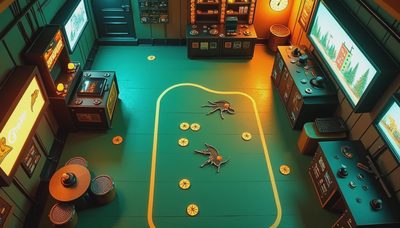
Isles of Sea and Sky is the kind of indie game that does not need to announce its importance. It places you on a chain of floating islands, gives you a few simple rules to understand, and lets curiosity do most of the work. The result is a puzzle adventure with a soft visual identity and a surprisingly firm sense of place. It feels made for players who like discovery to arrive gradually rather than through a constant stream of rewards.
A world built from color, space, and silence
The first thing that stayed with me was the shape of the world. Isles of Sea and Sky uses compact islands, open water, clean outlines, and bright blocks of color to create something that feels almost illustrated. The screens are readable without looking sterile. A blue stretch of sea separates one idea from the next, while a patch of grass, stone, or sand quietly tells you where your attention should go.
That clarity matters because the game asks you to look closely. The environments are not just backdrops for puzzles. Their arrangement becomes a kind of visual language. A narrow path suggests a sequence. An isolated object raises a question. A strange gap in the landscape can feel more inviting than a glowing objective marker. I found myself pausing between attempts simply to read the composition of a room.
The sound design works in the same restrained register. There is no need for a dramatic score to tell you that a solution matters. Small effects, ambient space, and the movement of your character give each action enough weight. Isles of Sea and Sky is quiet, but it is not empty. Its silence leaves room for the player to notice things.

Puzzles that teach without overexplaining
At its center, Isles of Sea and Sky is about pushing objects, navigating hazards, opening routes, and learning how different pieces of the environment interact. The early puzzles introduce their ideas with a light touch. You are rarely handed a long explanation. Instead, the game gives you a safe space, a new object, and enough room to test what happens.
That approach makes progress feel personal. When a solution clicks, it usually comes from remembering something the game showed you earlier and applying it in a new arrangement. The rules are simple enough to understand, but their combinations can become wonderfully stubborn. A move that looks harmless can close off a route. A block placed in the wrong square can force you to reconsider the whole room.
The best puzzles create that familiar quiet tension: you know the answer is somewhere in the arrangement, but you have not yet learned how to see it. Isles of Sea and Sky does not rely on obscure logic for its difficulty. It asks for patience, spatial memory, and a willingness to undo your assumptions. When a puzzle feels difficult, the problem is usually your reading of the space rather than a hidden trick.
There are moments when the game pushes a little harder, especially when several mechanics overlap. Those sections can slow the pace, but they also give the journey texture. Without resistance, exploration would become decoration. Here, a troublesome room can make the next island feel newly open.
Exploration that respects your attention
A lot of exploration games confuse size with generosity. Isles of Sea and Sky takes a different route. Its world is made from discrete places, but the boundaries between them still suggest a larger geography. You can see islands waiting in the distance, notice paths that are not ready to be crossed, and return to familiar areas with a better understanding of what they contain.
This structure rewards memory without turning the game into a checklist. I appreciated that the map does not constantly pull me toward the next objective. The feeling is closer to walking through a small gallery or turning over objects in a thrift-store bin: there is a clear invitation to look, but no pressure to hurry.
The game also understands the pleasure of revisiting a place. A location that first seemed sparse can become legible after you learn a new interaction. The change is not always dramatic. Sometimes it is simply the satisfaction of recognizing a possibility that was visible all along. Isles of Sea and Sky trusts that recognition to be rewarding on its own.

How it feels to play over a few evenings
This is a particularly good game for short sessions. A single puzzle can take ten minutes, while a longer stretch of exploration can fill an evening without demanding that you remember a complicated story. The gentle presentation makes it easy to return after a day away, and the clear rules help you recover your place quickly.
That does not mean the experience is weightless. Some puzzles can produce the kind of frustration that follows you away from the screen. I have caught myself sketching a room in the margin of a notebook, not because the game requires it, but because drawing the arrangement helped me see the problem differently. For an illustrator, that is a good sign: the visual design is doing real cognitive work.
There is also a pleasing contrast between the game’s friendly colors and its occasional severity. The world looks welcoming, but it will not solve every problem for you. That balance keeps the mood from becoming overly cute. Isles of Sea and Sky has warmth, yet it still believes the player can sit with uncertainty.
Who should play Isles of Sea and Sky?
Isles of Sea and Sky is a strong recommendation for players who enjoy environmental puzzles, compact exploration, and games with a distinct visual voice. It should appeal to fans of Sokoban-style thinking, minimalist adventure games, and experiences where the satisfaction comes from understanding a system rather than collecting constant upgrades.
It is less suited to anyone looking for combat, character-heavy drama, or a densely scripted narrative. The game’s story and atmosphere work through suggestion. If you need frequent dialogue, cinematic momentum, or a large inventory of abilities, its restraint may feel too slight. That is not a flaw so much as a clear artistic choice.
The price is easiest to justify if you value a game that can occupy your thoughts between sessions. This is not a disposable weekend spectacle. Its appeal is in the small afterimages: a color combination, an island seen from the water, a puzzle solution that suddenly reorganizes the whole screen in your mind.
Final judgment
Isles of Sea and Sky is thoughtful, visually composed, and confident enough to leave space around its ideas. It does not reinvent puzzle exploration, but it understands why the form works: a simple rule, a readable room, and enough time for the player to find meaning in the arrangement.
If you want a calm game with real friction beneath its gentle surface, this is worth your time. Play it when you can give yourself a few unhurried evenings, preferably without a guide open beside you. The pleasure is not only in reaching the next island. It is in noticing why the path was there. If it stays with you, it counts.