The battle princess madelyn indie game arrives with the bright confidence of a lost cartridge pulled from a bedroom shelf. Its pixel art is colorful, its heroine is immediately readable, and its opening hours make no attempt to hide the arcade games that shaped it. This is a side-scrolling action adventure about a young knight fighting through haunted places to save her kingdom, her family, and her ghostly dog companion. It is also a game with a particular kind of friction: charming in its details, sometimes demanding in its structure, and best approached by players who enjoy learning a hostile map one mistake at a time.
I spent much of my first session noticing the art before thinking about optimization. Madelyn's red hair, armor, and blue-toned surroundings create a clean silhouette, while graveyards, castles, forests, and underground spaces each have their own visual temperature. Nothing here is trying to look realistic. The pleasure comes from composition: a moon behind crooked trees, a monster entering from the edge of the screen, a small character animation that gives a room more personality than its size suggests.
What kind of game is it?
At its core, Battle Princess Madelyn indie game is a retro-style platform adventure with melee combat, exploration, boss encounters, and light role-playing progression. The most obvious reference point is the old Ghouls 'n Ghosts tradition, especially in its armored hero, dangerous stages, projectile-heavy enemies, and willingness to punish careless movement. Yet it is not simply a museum piece. Madelyn can gain equipment and abilities that open new routes, and the world has enough backtracking to give the journey a metroidvania-like shape.
That combination creates an unusual rhythm. One moment is about clearing bats and armored creatures from a narrow platform. The next asks you to remember a blocked passage from twenty minutes earlier. The combat is straightforward rather than combo-driven, so positioning matters more than stylish input. You learn when to jump, when to throw a weapon, and when retreating is smarter than insisting on one more hit.
The battle princess madelyn indie game also separates its adventure from a purely linear arcade run through exploration. Some objectives send you back into familiar areas, and the map can feel less like a sequence of stages than a set of illustrated rooms connected by memory. That design will appeal to patient players, though anyone expecting a brisk, perfectly signposted campaign could find the structure muddy.
Pixel art with a real sense of place
The strongest reason to look at Battle Princess Madelyn indie game today is its visual identity. The pixel art is not merely a resolution choice or a nostalgia filter. It gives the game a storybook surface, with chunky silhouettes, saturated effects, and backgrounds that feel assembled from painted layers. There is a theatrical quality to the enemies, too. Skeletons, ghosts, insects, and larger bosses are designed to be understood instantly, even when the screen becomes busy.
Color does much of the emotional work. A cold blue cemetery feels exposed and watchful, while warmer interiors offer a temporary sense of shelter without becoming safe. The palette can be loud, but it is rarely anonymous. As an illustrator, I like that the environments often frame Madelyn clearly instead of drowning her in decorative noise. The character remains the visual anchor, which is essential in a game where a missed attack or hidden ledge can change the outcome of a room.
The animation is more uneven. Some enemies have wonderful, exaggerated movement, while certain interactions feel stiff or functional. That contrast is part of the game's independent character. You can see the ambition in the large scenes and bosses, but you can also feel the small-team compromises underneath. For me, those rough edges are easier to accept because the art direction has a point of view.
Combat, difficulty, and patience
The battle princess madelyn indie game is not designed around effortless momentum. Enemies often occupy awkward spaces, hazards appear close to your landing point, and bosses expect you to observe patterns rather than simply trade damage. A shield, ranged weapon, or upgraded ability can change how a fight feels, but better gear does not remove the need for attention.
The difficulty is most interesting when it teaches. A projectile crossing the screen gives you a readable problem. A boss repeating a three-part attack creates a small rhythm to learn. It is less satisfying when damage feels connected to clutter, unclear collision, or a route that has not communicated its purpose. Those moments do not ruin the game, but they can turn a focused evening into a test of patience.
I would not recommend rushing through this one while multitasking. Play with a controller, keep your attention on the edges of the screen, and expect to revisit areas after finding new abilities. The battle princess madelyn indie game becomes more enjoyable once you treat failure as information instead of evidence that the controls are against you.
Storybook warmth beneath the armor
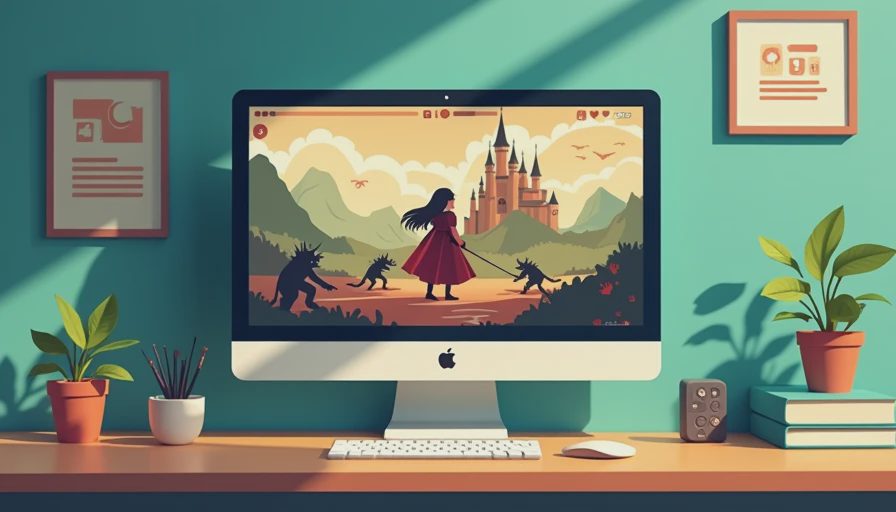
The story is deliberately simple, but it gives the journey a little emotional lift. Madelyn is not a silent avatar wandering through generic ruins. Her relationship with her dog companion adds a tender thread to the adventure, and the family-centered stakes make the rescue feel more personal than a standard “save the kingdom” prompt. The game does not linger on every character long enough to build a complex drama, yet its illustrated tone keeps the quest approachable.
That warmth matters because the environments can be grim. Tombs, ghosts, and ruined structures might otherwise make the campaign feel like a sequence of combat rooms. Small character moments and playful visual details soften the darkness. I found myself sketching the dog after playing, which is usually a sign that a design has crossed from competent into memorable. If it stays with you, it counts.
Who should play it?
The battle princess madelyn indie game makes sense for players who miss 16-bit and early 32-bit action adventures but want a newer game with more exploration. It is a good fit for someone who studies pixel art, enjoys boss patterns, or likes finding a hidden route after returning with a new tool. Fans of Ghouls 'n Ghosts, Wonder Boy, and classic Castlevania-style progression will understand its language quickly.
It is less suitable for players who want modern accessibility, constant forward motion, or a clean objective marker for every task. The experience can be unclear, and some backtracking asks for more memory than convenience-focused games do. Difficulty options and platform performance can also depend on the version you play, so checking the current store details before buying is sensible.
Final thoughts on the adventure
As an indie game, Battle Princess Madelyn indie game is most compelling when its visual instincts and old-school systems point in the same direction. The pixel art invites you into a colorful haunted storybook; the combat asks you to slow down and pay attention. That tension will frustrate some players, but it gives the game a texture that polished nostalgia products often lack.
I would recommend it to a patient player with a few quiet evenings, especially someone who values atmosphere as much as mechanical smoothness. I would skip it if punishing platform combat already feels like work. For everyone in between, the best approach is to sample a stage, notice how the world looks after the first defeat, and decide whether curiosity is winning over irritation. Not loud, just lasting.