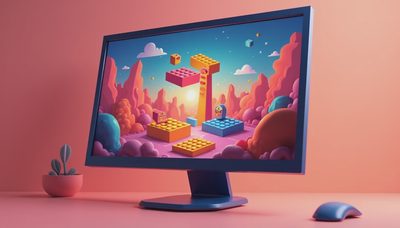
The Upturned is the kind of indie horror game that looks like a joke until it quietly gets under your skin. Its world is bright, blocky, and often ridiculous: a haunted hotel full of odd creatures, abrupt danger, and objects that seem to belong in a slapstick toy box. Then a hallway stretches too far, a room becomes strangely empty, or a sound arrives from somewhere you cannot see. The mood changes without asking permission.
I went in expecting a short curiosity and found something more carefully shaped than its first-person presentation suggests. The game is not interested in realistic fear. It builds unease from contrast, placing cartoon surfaces beside genuinely hostile spaces. That tension gives the experience its particular rhythm. You laugh, you explore, and then you start checking the corners before opening a door.
What The Upturned Does With Its Strange Setting
The Upturned takes place in and around a hotel that feels less like a believable building than a dream assembled from spare parts. Rooms connect in ways that are practical enough to navigate but never fully trustworthy. Hallways have the clean geometry of a simple game environment, yet the lighting and sound make them feel like stage sets after the audience has gone home.
That artificial quality is important. The game does not hide its low-poly construction, and it does not need to. Flat surfaces, blunt shapes, and exaggerated props create a visual language that is immediately readable. A bed is not just a bed; it becomes a place to search, hide, or wonder about. A doorway is not merely a transition. It is a dark rectangle waiting to alter the rules of the room behind it.
The humor keeps the atmosphere from becoming heavy. Strange enemies and awkward animations can provoke a real laugh, especially when an encounter goes wrong in a way that feels almost physical. Still, the comedy never completely dissolves the threat. The game understands that something silly can remain frightening if it is unpredictable enough.

The Horror Works Through Timing, Not Gore
The Upturned is strongest when it gives a quiet space time to breathe. It lets footsteps carry farther than expected. It leaves a room apparently harmless, then places one detail just outside the center of your view. This is familiar horror technique, but the presentation gives it an unusual softness. The danger does not arrive with a constant wall of noise. It appears, disappears, and leaves you alone with the possibility that it will return.
There is very little need for graphic imagery. Fear comes from movement, distance, and the game’s refusal to explain every oddity immediately. A creature may be visually absurd, but the uncertainty around its behavior makes it memorable. You are not simply asking whether it can hurt you. You are asking when it noticed you, whether it is still nearby, and whether the next room has changed while you were looking elsewhere.
That restraint makes the quieter sections valuable. Some players will find the pacing too loose, especially if they want a tightly directed horror campaign with constant escalation. I liked the pauses because they gave the setting room to develop its own personality. The hotel feels less like a sequence of scares and more like a place with bad intentions.
Movement Gives The Upturned Its Physical Personality
The Upturned is not a game about complicated systems. Its appeal comes from the way movement, searching, and sudden danger fit together. Exploring a room requires attention to ordinary objects, while escape sequences make the same spaces feel compressed and unfamiliar. A corridor you crossed casually can become a problem once something is following you through it.
The physical comedy matters here. An encounter may look strange rather than polished, but that roughness gives the game an unstable quality. Animations can feel exaggerated, and the world sometimes seems to wobble between horror scene and homemade stage play. Instead of weakening the atmosphere, that friction becomes part of the identity. The game is unsettling because it never settles on one emotional register.
There is also a useful sense of scale. The player often feels small without the game needing to present enormous monsters or elaborate set pieces. A narrow passage, a cluttered room, or a locked route can create pressure through simple spatial design. The best moments are not about mastering a difficult mechanic. They are about realizing that the shape of a place has become threatening.

Why The Upturned Feels Better Than Its Premise Sounds
On paper, The Upturned can sound like a collection of familiar indie horror ingredients: a strange location, cartoon creatures, exploration, and sudden scares. What separates it is the confidence of its tone. It does not apologize for being silly, and it does not use seriousness as proof that the horror matters. The result is lighter on the surface but more distinctive than many games that imitate a darker visual style.
The sound design does a lot of quiet work. Empty rooms have enough presence to keep them from feeling like unfinished spaces, while sudden effects interrupt the calm without turning every moment into a warning siren. Audio also helps sell the distance between the player and whatever may be waiting nearby. You listen before you see, which gives familiar environments a second life.
The visual design has a similar economy. Color and shape do not create a sophisticated cinematic image, but they create something easier to remember. I can recall the feeling of moving through its rooms more clearly than I can recall every individual scare. That is a good sign for a game this short. If it stays with you, it counts.
Who Should Play The Upturned?
The Upturned suits players who enjoy compact horror with an unusual sense of humor. It is a good choice for a late-night session when you want atmosphere and surprise without committing to a sprawling survival horror game. Fans of stylized indie projects, oddball first-person exploration, and games that feel handmade will find more to appreciate here than players looking for elaborate combat or realistic environments.
It is less convincing as a traditional action game. The mechanics are there to support the mood, not to provide a deep skill ladder. If you want weapon upgrades, complex puzzles, or a large map full of optional systems, this hotel will feel thin. Its rewards are tonal: a memorable image, a funny encounter, a room that makes you pause before stepping inside.
That narrow focus is also why the game works. It does not stretch a small idea across dozens of hours. The experience knows its best material is the contrast between charm and discomfort, then keeps returning to that contrast from slightly different angles.
Final Verdict on The Upturned
The Upturned is not polished in the conventional, high-budget sense, and its rough edges are visible. Yet the roughness feels connected to its personality rather than accidental. It has an eye for strange spaces, a good instinct for silence, and enough humor to make its unsettling moments land harder.
I would recommend The Upturned to players who prefer horror with a crooked smile. Go in expecting a focused indie experiment, not a definitive nightmare or a mechanically rich adventure. Give the rooms time to speak, let the oddness accumulate, and avoid judging the game by its first goofy encounter. The strongest impression arrives gradually, after the jokes and scares begin sharing the same hallway.
For a short, visually distinctive game that respects your time, this is an easy recommendation. Not loud, just lasting. The Upturned understands that horror does not always need darkness; sometimes it only needs a familiar room, one wrong detail, and enough silence for you to notice it.