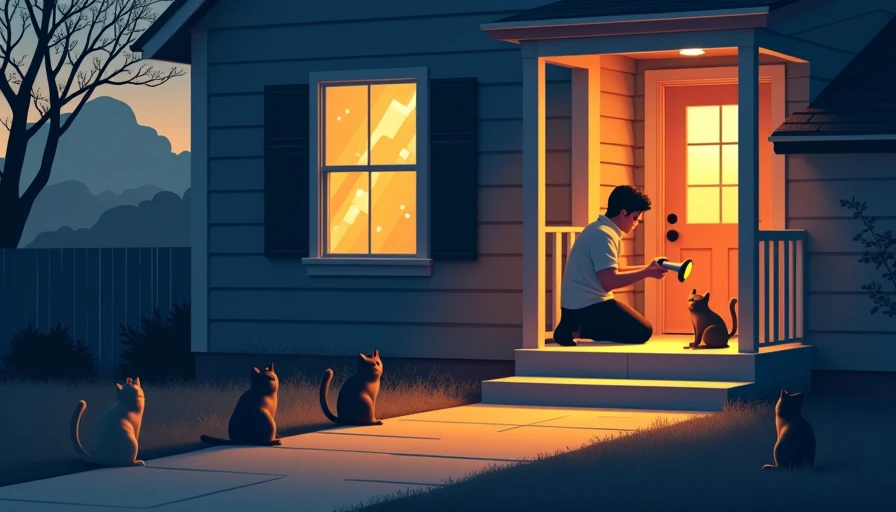
Six Cats Under begins with a premise that sounds like a joke told softly: a dead woman, six trapped cats, and one last chance to help them. Six Cats Under is a short point-and-click puzzle game, but its real subject is attention. It asks you to look closely at an ordinary room, notice what has been left behind, and use the small pieces of a life to make something gentler possible.
I came to it expecting a pleasant browser diversion and found a game with a surprisingly clear visual voice. The drawings are loose without feeling careless. Objects sit in rooms with the calm specificity of things someone has actually lived around: a chair, a shelf, a window, a cluttered corner. Nothing is polished into sterility. The lines retain the warmth of a sketchbook page.
What Six Cats Under Is Actually About
The setup gives away the broad shape of the story, yet the game is not interested in turning death into a dramatic spectacle. The protagonist is already gone when play begins. There is no long explanation, no heavy soundtrack insisting on grief, and no elaborate mythology to make the premise feel important. Instead, the game lets absence appear through the spaces she can no longer occupy.
That restraint is one of its strongest choices. You understand the character through her belongings and the animals she cared for. A room becomes a kind of portrait, not because it contains a biography in neat pieces, but because its arrangement suggests habit. The game trusts the player to connect those details. I liked that trust. It gives the apartment a quiet emotional pressure without asking for tears on command.
The cats are not interchangeable objectives, either. Their placement gives the apartment a gentle rhythm of discovery. One solution leads your eye toward another corner, another object, or another small visual joke. The writing stays light enough to keep the game from collapsing under its own sentiment. There is sadness here, but it is held beside curiosity and affection.

Puzzles Built From Looking, Not Grinding
Six Cats Under uses familiar point-and-click language: move through a compact space, inspect objects, combine clues, and try actions that seem plausible. The important difference is the scale. This is not a sprawling adventure designed to occupy an entire weekend. Its puzzles are concentrated, readable, and shaped around the apartment rather than pasted onto it.
Most solutions come from paying attention to visual relationships. A thing that appears decorative may be a useful tool. A blocked route may become meaningful once you understand how the room is arranged. The best moments feel less like guessing the developer’s password and more like noticing what was in front of you all along. That distinction matters in a short game. There is little room for an arbitrary puzzle to derail the mood.
I still had a couple of moments where I clicked around more widely than I wanted, especially when I suspected an object mattered but had not found the right interaction. Even then, the friction never became exhausting. The game is generous with its scale and clear enough in its visual language that experimentation feels natural. You are not managing an inventory full of junk. You are reading a small illustrated space.
That makes Six Cats Under a good recommendation for players who like puzzle games as acts of observation. If you want elaborate systems, escalating difficulty, or a mystery that keeps branching outward, this will feel slight. If you enjoy finding the right shape in a room, it lands with unusual precision.
The Art Direction Does Most of the Emotional Work
The hand-drawn presentation is not simply a charming wrapper. It controls the distance between you and the story. The irregular outlines make every object feel touched by a person rather than generated for a function. Even the interface stays close to the page, keeping you inside the same visual world as the characters and furniture.
Color is used with similar restraint. The apartment has the muted, lived-in feeling of a place seen late in the afternoon. Against that quiet palette, the cats read immediately as moving points of personality. They are expressive without being overanimated, and their presence changes the emotional temperature of each room. A space that first feels empty becomes occupied again through movement.
This is where Six Cats Under reminded me of a good illustration. A strong image does not explain every mark. It leaves enough open space for your own attention to complete it. The game’s best scenes work that way. You notice a small arrangement, pause, and realize the scene has said more than its dialogue needed to say.

How Long Is Six Cats Under?
The game is short, and that is central to its appeal rather than an apology for it. A careful first playthrough can fit comfortably into an evening, depending on how quickly you read the room and whether you solve every interaction without hints. There is no bloated progression system, no needless backtracking designed to inflate the clock, and no repetitive challenge ladder after the emotional arc has finished.
That economy makes the ending work. Six Cats Under knows that a small gesture can become less meaningful when it is repeated too many times. It builds toward completion without trying to become a bigger game than it is. For players with a crowded backlog, that is valuable. You can start it after dinner, follow its thread, and finish with a distinct memory instead of another unfinished obligation.
The short runtime also makes it easy to recommend as a shared play experience. One person can handle the controls while another watches for clues. It has the kind of puzzles that invite quiet conversation rather than frantic backseat gaming. I could imagine playing it with someone who does not usually play adventure games, because the emotional premise is immediately legible and the interaction language is not intimidating.
Who Should Play It?
Play Six Cats Under if you want an indie game with a strong sense of place, compact puzzles, and an emotional center that stays modest. It is especially suited to players who enjoy hand-drawn art, small domestic stories, and games that respect their own limits. It would sit comfortably beside other thoughtful short adventures in a patient-gaming queue, particularly when you want something warmer than a horror game but more textured than a purely cozy distraction.
You should probably skip it for now if you need constant mechanical novelty or a long narrative with several major reversals. The game does not hide what it is. Its pleasure comes from tone, observation, and the gradual recognition that a room can carry a person’s care after that person is gone.
I finished Six Cats Under with the familiar feeling I get after closing a small illustrated book: not overwhelmed, exactly, but gently rearranged. The game does not demand that you call it profound. It simply gives you six cats, a quiet apartment, and enough room to notice why helping matters. If it stays with you, it counts.